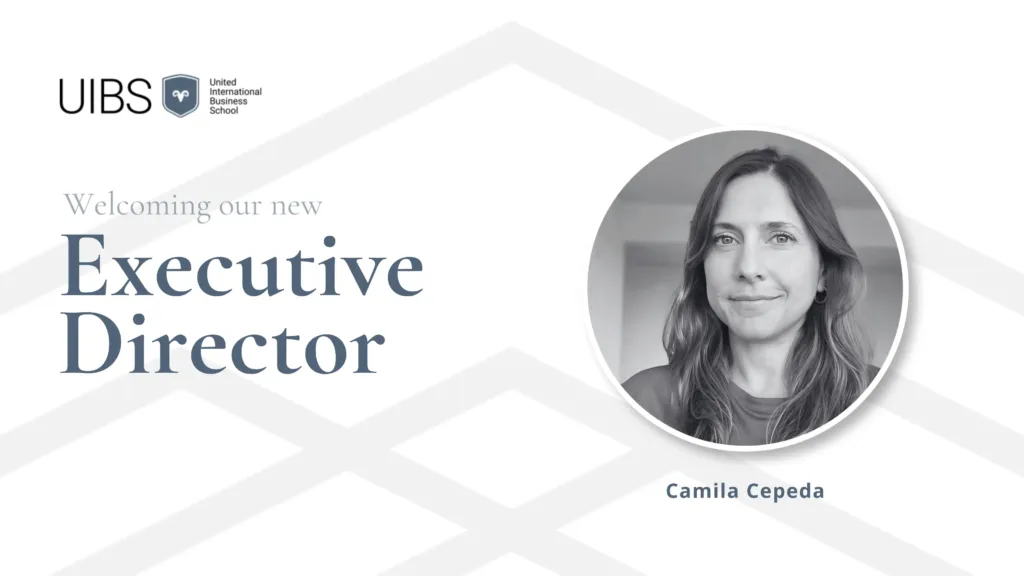
We are excited to announce the appointment of Camila Cepeda as our new Executive Director. Camila brings a wealth of experience in higher education and will lead our Institutional Governance Team, a cornerstone of our evolving organizational model. Her role encompasses guiding strategic initiatives, fostering collaboration across teams and committees, and ensuring that our institution remains agile and forward-thinking.
Distributed Leadership
In today's rapidly evolving higher education landscape, we are committed to staying ahead by fostering flexibility and innovation. To achieve this, we've embraced Distributed Leadership, a dynamic approach that decentralizes decision-making and empowers specialized teams and committees to lead within their domains. Rather than concentrating power at the top, this model creates a network of interconnected teams, from Curriculum Development and Student Advancement to Digital and Human Resources, each contributing expertise to institutional success.
Distributed leadership is more than an organizational choice; it's a philosophy and a commitment to shared responsibility and dynamic collaboration. Research from leading institutions highlights that inclusive and distributed structures enhance responsiveness, foster innovation, and build trust among stakeholders. This approach reflects what is called an Octopus Organization, a structure where each arm (team) acts autonomously yet remains connected to a central vision, enabling responsiveness and innovation.
Reflecting on her role within this model, Executive Director, Camila Cepeda, notes:
"Stepping into this role, my priority is to strengthen the connective tissue of our octopus organization, ensuring that every team feels empowered while staying aligned with a shared vision. Distributed leadership isn't just our structure; it's our commitment to trust, transparency, and continuous learning, enabling us to respond to the needs of students and colleagues with agility and purpose."
By adopting distributed leadership and embracing the octopus model, we position ourselves as a learning, adaptive institution ready for the future of higher education. Octopus organizations thrive through continuous learning, radical transparency, and technology-enabled connectivity, principles we are embedding into our culture.
The Executive Director as Connector-in-Chief
In distributed leadership, the Executive Director's role is coordination, not centralization of the various teams. Camila will align team responsibilities, clarify decision rights, and build the conditions (trust, transparency and, shared purpose) that are essential to academic governance effectiveness.
Research underscores that executive leadership is a team sport that requires clear charters, mechanisms for alignment, and deliberate conflict resolution to unlock the benefits of shared authority. As the coordinating 'head' of our octopus organization, Camila ensures that autonomous teams remain aligned with institutional goals while retaining the flexibility to act quickly.
Reflecting on what the institution has learned, Representative Director, Thierry Kirschstein, adds:
"What we have learned over the past years is that the complexity and pace of modern higher education demand a different kind of leadership, one that cannot rely on centralized control. Research and our own experience have shown that institutions thrive when decisionmaking is distributed, transparency is the norm, and teams are empowered to act with autonomy and trust. But autonomy alone is not enough: each team must be guided by capable team leads who are equipped to coordinate across domains, steward shared governance, and uphold our institutional mission. This is why we are embracing the octopus organization model, a structure where shared intelligence, continuous learning, and strong, responsible leadership come together as operational principles. Camila's leadership embodies this next chapter of our evolution."
Mini-Case 1: How the Student Advancement Team Delivers Impact
Our Student Advancement Team exemplifies distributed leadership in action. Each student is paired with a dedicated advisor who maintains frequent, personalized contact throughout the academic journey, from application to graduation. One common scenario involves students who decide to change programs, such as moving into a Global Bachelor or Global Master track. This transition requires careful planning of courses across multiple campuses and academic partners. Advisors take the lead in coordinating with our Curriculum Development and Education Services teams, and with our international partners to ensure a seamless progression plan. By acting as connectors and problem-solvers, advisors empower students to navigate complex academic pathways confidently, demonstrating how distributed leadership supports flexibility and success.
Mini-Case 2: How the Digital Resources Team Drives Innovation
The Digital Resources Team demonstrates distributed leadership by spearheading technology initiatives that enhance learning and operational efficiency. Rather than waiting for top-down directives, this team actively listens to student feedback and acts on emerging needs. For example, when students highlighted challenges with delayed insights into their academic progress, the team collaborated with our Curriculum Development team and external IT partners to integrate a program progression dashboard directly into our existing course enrollment platform. This feature now provides up-to-date visibility into completed credits and remaining requirements, empowering students to plan ahead and make informed decisions. By responding directly to student-driven insights and working across teams, the Digital Resources Team ensures that technology decisions are informed, dynamic, and aligned with the learner experience, showcasing how distributed leadership accelerates innovation and responsiveness.
Further reading
- Werner, J., & Le‑Brun, P. (2025). Become an octopus organization. Harvard Business Review. https://hbr.org/2025/11/become-an-octopus-organization
- American Institutes for Research. (2022). Advising for college success: A systematic review of the evidence. College Completion Network. https://files.eric.ed.gov/fulltext/ED626933.pdf
- Benson, T. D. (2025, December 16). COACHE marks two decades of faculty-focused change with release of 20th anniversary impact report. Harvard Graduate School of Education News. https://www.gse.harvard.edu/ideas/news/25/12/coache-marks-two-decades-faculty-focused-change-release-20th-anniversary-impact
- COACHE. (2021). Effective academic governance: Five ingredients for CAOs and faculty. Harvard Graduate School of Education. https://coache.gse.harvard.edu/publications/effective-academic-governance-five-ingredients-caos-and-faculty-0
- Somers, M., Ancona, D., & Isaacs, K. W. (2022, April 19). Why distributed leadership is the future of management. MIT Sloan Management Review. https://mitsloan.mit.edu/ideas-made-to-matter/why-distributed-leadership-future-management
- Stamou, P., & Tsoli, K. (2024). The role of counseling for non-traditional students in formal higher education: A scoping review. Frontiers in Education, 9. https://doi.org/10.3389/feduc.2024.1361410
- Wassenaar, C. L., Pearce, C. L., & Lorinkova, N. (2025). Shared Leadership 2.0: Taking stock and looking forward. Cambridge University Press. https://doi.org/10.1017/9781009560467