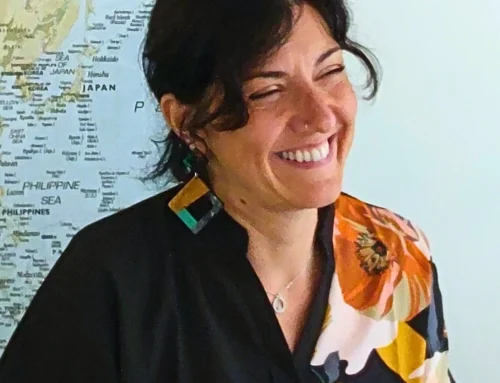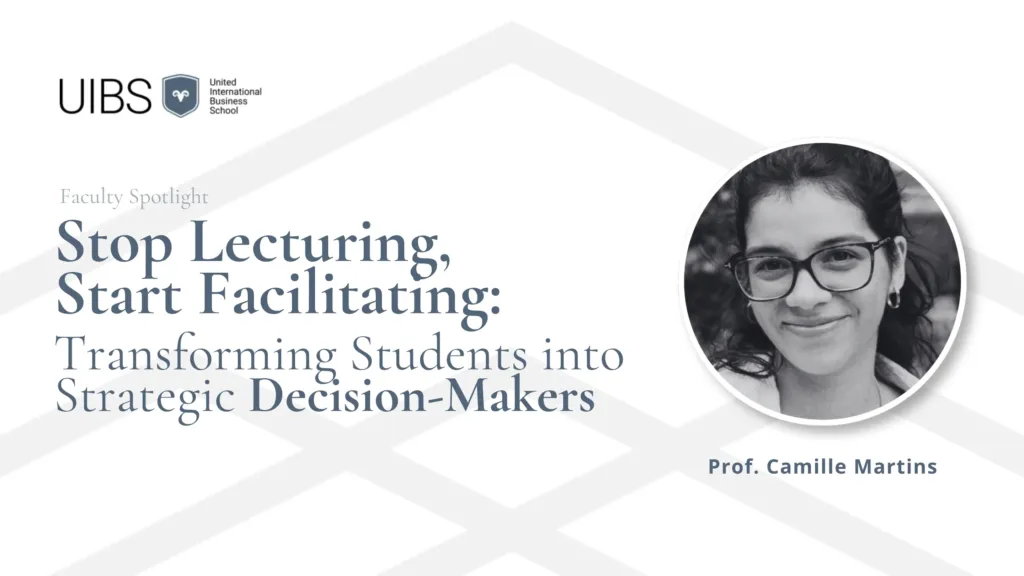
For Camille Martins, the classroom is not a space for passive listening, but a training ground where students negotiate, debate, and navigate complex ethical and cultural dilemmas in real-time. In this interview, we explore how she transforms “cultural clashes” into breakthroughs, why she views sustainability as the ultimate competitive advantage, and what it truly means to prepare students for the demands of the global professional world.
Most educators talk about “Active Learning,” but you actually live it. If we walked into your classroom mid-session, what is the most surprising or unconventional thing we might see happening during a flipped classroom or experiential project?
If you walked into my classroom mid-session, you would probably find me walking around the room, while students are clustered in small teams, negotiating roles, and “teaching” each other the concepts they had prepared in advance through flipped materials. According to various pieces of research on flipped classrooms, when content is moved outside class time, in-class activities can focus on higher-order skills such as analysis and evaluation rather than passive listening, which is exactly what I aim to do.
A typical scene might be students running a live simulation of a board meeting or stakeholder negotiation, where each group represents a different actor: local community, investors, regulators, or representatives of the business we are discussing. Their task is to apply the theory they studied before or during class to defend their position using data and strategic arguments.
This approach aligns with evidence that experiential and flipped learning in business education increases engagement and performance while empowering students to work closely with real or simulated communities and organizations, which I believe is infinitely more valuable to students. In this setting, my role shifts from “lecturer” to facilitator and process coach, intervening only to structure reflection and ensure everyone’s voice is heard.
Nowadays, information is constantly available and often overwhelming, so I place a strong emphasis on teaching students not just what to know, but how to use knowledge responsibly and intelligently. In my class, I deliberately design activities that force students to assess the quality of evidence, compare conflicting data sources, and distinguish robust research from anecdotal or biased claims. This helps them develop the habit of asking: Where does this evidence come from? Who benefits from this interpretation? What assumptions are hidden here? By turning these questions into a routine, students learn to judge the credibility of information rather than simply accepting it at face value.

At the same time, I push them to apply this critical thinking across different contexts and projects, so that theory does not remain abstract but becomes a flexible toolkit of soft skills.
Whether they are negotiating with stakeholders, designing a business model, or responding to an unexpected market shock, these habits of questioning, synthesizing, and adapting help them make more informed, reflective decisions. In this way, the classroom becomes a training ground where information literacy and critical thinking evolve into almost instinctive professional competencies that they can carry with them throughout their careers.
In a global hub like United International Business School , “cultural clashes” are often seen as hurdles. Can you share a specific moment where a bias or a clash in your classroom actually turned into a breakthrough learning opportunity for the students (or even for you)?
In one project, a multicultural team was working on a market-entry strategy and a disagreement emerged around work pace and communication styles. Some students perceived direct feedback as rude, while others felt indirect comments were inefficient. Initially, this “clash” risked derailing the project, but instead of smoothing it over, I paused the task and turned it into a structured debrief on cultural assumptions in business. Research on intercultural classrooms suggests that such clashes, when facilitated carefully, can become powerful moments to surface implicit norms and foster deeper understanding between students.
We mapped each student’s expectations about hierarchy, time, and communication on a whiteboard and connected them to frameworks they had studied in international management. By reframing the conflict as data, students realized they were not dealing with “difficult personalities” but with different cultural lenses. Intentionally working through these tensions—rather than avoiding them—helps students appreciate diverse perspectives and reduces groupthink in international contexts.
Classes at UIBS are incredibly culturally diverse, and even though I have experience working with people from different countries and varied upbringings, it was initially challenging for me to facilitate discussions where the line between constructive debate and offense is very thin. There were a few moments when students felt hurt by a thoughtless comment from a peer or by one of my deliberately provocative statements meant to push them into more extreme positions and ignite deeper discussion. In those situations, my strategy is to pause, acknowledge the emotional impact, and then guide everyone back to the core purpose of the debate: learning, not winning. I invite the group to unpack the underlying assumptions, clarify intentions, and reframe the discussion in strictly academic and respectful terms.
Over time, I’ve worked hard to strike a balance between “pushing” them to confront uncomfortable ideas and “pulling” the conversation back into a safe, constructive space; I now feel I have developed a good balance between provoking critical thinking and keeping the classroom environment collaborative and inclusive.
Embedding ESG (Environmental, Social, and Governance) metrics into projects can sometimes feel like a “compliance” exercise for students. How do you flip the script so they see sustainability not as a constraint, but as the ultimate competitive advantage in the modern business world?
I start by treating ESG not as an “extra slide” at the end of a project but as a core driver of strategy and long-term value creation. Business education literature and executive education programmes increasingly emphasize that companies integrating sustainability into their core models can reduce risk, innovate, attract talent, and outperform competitors over time. In class, I show short, up-to-date cases where firms used ESG to enter new markets, secure funding, or protect their reputation during crises, so students see tangible competitive benefits rather than abstract obligations.
Then, in experiential projects, teams must justify key decisions—market selection, supply chain design, financing choices—through explicit ESG trade-offs. They are asked, for example, to compare two strategies: one with a lower short-term financial return but higher ESG performance, and one that maximizes short-term profit but increases regulatory and reputational risk. Recent discussions in business practice and education show that when students analyze sustainability in this integrated way, they begin to view ESG as a source of innovation and resilience, not just reporting. By the end of the project, many teams voluntarily foreground ESG in their investor pitches, because they recognize that in a modern business environment, responsible strategy is often the most competitive one.

A core thread running through many of my classes is ethical business management. I don’t see business as a game of pure extraction, but as a system where every decision has ripple effects on people, communities, and the environment.In my view, an economy that only takes and never gives back is not only unsustainable but also morally flawed. Of course, I fully recognize that a businessman is entitled to profit, given the risks they voluntarily assume and the value they bring to the market. However, I would never justify that profit if it comes at the direct cost of workers’ dignity, safety, or fair treatment, or if it exploits the final consumer through deception, hidden costs, or manipulative practices.
That’s why I constantly push students to consider the broader consequences of their choices: how a cost‑cutting decision might harm workers, or how a misleading marketing claim can damage trust and reputation. I make it clear that misconduct—whether in finances, labor practices, or communications—always carries consequences, often long after the initial “win.”
By framing ESG and sustainability as expressions of ethical responsibility, not just technical metrics, I help students internalize the idea that responsible management is not a side issue, but the very foundation of resilient, respected, and competitive businesses.
You bridge the gap between complex theory and hands-on application. When you are designing a new experiential project, what is the “secret ingredient” you include to ensure students stay motivated when things get challenging or messy?
My “secret ingredient” is building in a realistic stakeholder and feedback loop that makes consequences visible. Projects are most engaging when students see a clear impact and receive iterative feedback from real or simulated stakeholders, not just from the instructor. So when I design a project, I always give students a concrete audience: a simulated board, a panel of “clients,” or external professionals.
In almost every class, I deliberately include at least one structured debate as a core activity, because I genuinely believe it is one of the most effective ways to get students engaged and to activate their critical thinking. Most of the time, it ends up being the activity students enjoy the most: actively arguing with peers who have the same level of content knowledge, rather than “fighting” against the professor levels the playing field and makes the discussion feel more authentic and dynamic. The debate itself pushes them to think on their feet, anticipate counterarguments, and back up their claims with evidence. After a while, they realize that the real goal is not to confront or defeat the counterpart personally, but to win the debate by constructing the strongest, most logical, and best‑supported argument. As a result, their reasoning becomes sharper, more structured, and more persuasive, which is exactly the kind of skill I want them to carry into real‑world business situations.
This structure does two things. First, it normalizes the idea that “messy” is part of learning—challenges are framed as data to iterate on, not as failure. Second, it taps into students’ intrinsic motivation: they want to perform well for someone beyond the professor. Evidence from business schools shows that experiential projects with community partners, simulations, or live cases increase students’ ownership and persistence, especially when combined with flipped classroom methods that free class time for active problem-solving.
If you could give one piece of “unfiltered” advice to a student about to start their first major experiential project under your guidance, what would it be to help them survive and thrive in your teaching ecosystem?
My unfiltered advice would be: “Treat your project like a professional commitment, not a school assignment—show up prepared, communicate openly with your team, and be ready to be uncomfortable.” I tell students that the real learning happens in the moments when the group disagrees, when the data does not fit their initial hypothesis, or when feedback is tougher than expected.
When students approach me to discuss their personal projects or ask for advice, I usually give them a small, concrete task that mirrors a real‑world professional deliverable—like a one‑page proposal, a SWOT analysis, or a preliminary pitch deck—and then judge them based on how complete and thoughtful that first deliverable is, even though it’s outside the strict confines of the university curriculum. Most of the time, they still treat it like a regular assignment: they submit something basic, surface‑level, or incomplete, missing the chance to truly explore their idea in depth. At that point, I sit down with them one‑on‑one, walk through the deliverable line by line, and show them everything that could be improved, from structure and clarity to assumptions and evidence. This way, they quickly learn that “just enough to pass” is not enough in the real world, and that the quality of their initiative and preparation is what actually opens doors and earns trust in professional settings.
I also remind them that in an international classroom, their ability to listen across cultures, manage conflict, and integrate ESG or ethical considerations into their decisions will matter as much as their technical analysis. Students who embrace reflection, dialogue, and iterative improvement gain not only better grades but also skills that transfer directly to global workplaces.